

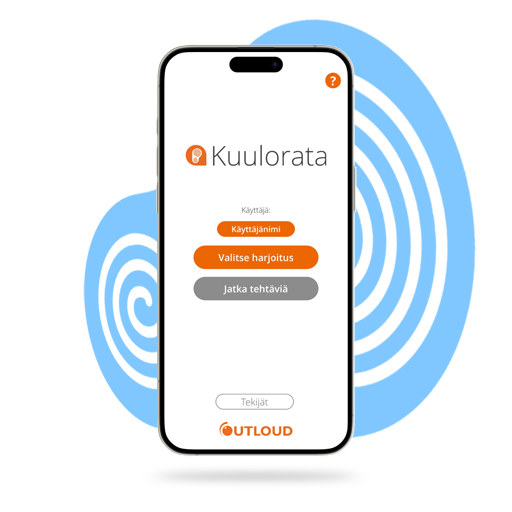
Kuulorata is an app for auditory training. You can do speech exercises, music exercises and games at different difficulty levels. There are plenty of tasks, and the app randomly selects fresh content for them. You can repeat the exercises and improve on your previous results.
Improve listening accuracy with Kuulorata
Would you like to get used to different sounds, practise listening or understand speech more accurately? If you have an Android or Apple mobile phone or an iPad, you can download Outloud’s free auditory training app from the app store to practise recognising words and sentences and listening to music.
An easy-to-use app
Kuulorata is clear and straightforward to use. Its ease of use and game-based activities support independent practice. You can choose the difficulty level, and the app gives you feedback on your performance and progress. The game-based format makes the exercises engaging: practise with sentence-completion tasks, memory games and bingo while having fun!
The app’s exercises feature a female and a male speaker. You can choose to listen to either voice or try both.
With Kuulorata, you can listen to words and sentences
- without background noise
- with steady background noise
- with background speech babble
- with reverberation
Why practise listening?
Kuulorata helps you practise your listening skills. The app contains a range of music and speech exercises and games. Research shows that auditory training benefits people who use hearing devices [1]. Simply starting to wear a hearing aid regularly begins the process of auditory rehabilitation: sounds become louder and previously inaudible sounds become audible. Adding focused auditory training to this full day of listening to everyday sounds brings further benefits.
Auditory training also supports brain functions involved in processing sound, such as auditory memory [2].
Kuulorata aims to support independent practice through its game-based activities and ease of use [3]. As well as speech-listening exercises, we recommend trying the app’s music exercises. Listening to music develops a range of auditory skills, including distinguishing, recognising and locating sounds [4].
Auditory training aims to
- help people get used to hearing aids and cochlear implants.
- increase the benefit they gain from these devices.
- encourage regular use of the devices.
Help with using and getting used to a hearing aid or cochlear implant
Sari Vikman, a speech and language therapist at the Tays Hearing Centre, is one of the group of therapists who developed exercises for Kuulorata. She explains that listening with hearing aids or a cochlear implant often takes practice to gain the greatest benefit. Drawing on her extensive clinical experience, Sari says: ‘Speech is hardest to understand when there is background noise or the room is reverberant.’
Using a hearing aid or cochlear implant and doing auditory training can help people understand speech more clearly. This usually makes social interaction easier and gives people more confidence to take part. Research has also shown that using hearing effectively helps maintain mental alertness.
Listening to music develops a range of auditory skills, including distinguishing, recognising and locating sounds. Research has demonstrated a strong link between music and speech perception. ‘That is why we wanted music to play a significant role in Kuulorata and created a wide range of exercises for distinguishing and recognising sounds, instruments and pieces of music,’ explains Kerttu Huttunen, a speech and language therapist and Professor of Logopedics at the University of Oulu. Kerttu is delighted that talented students and colleagues performed the music for the exercises. We therefore strongly recommend trying the app’s music exercises alongside speech-listening practice.
Kuulorata is the result of many years of development
The need for auditory training grew particularly strongly in the 1990s, when cochlear implants became part of auditory rehabilitation. Getting used to a new hearing device, whether a hearing aid or a cochlear implant, often takes practice at first.
Speech and language therapist Eila Lonka and phonetician Reijo Aulanko translated and adapted auditory training materials from cochlear implant manufacturer Cochlear into Finnish. Puheterapeuttien Kustannus published the printed Kuulorata käyttöön materials in 1999. As mobile phones became widely used by children and adults, speech and language therapist Sari Vikman identified a need to make the training materials digital. This led to Outloud’s KuulorataPilot app in 2017, which became the basis for the current Kuulorata app. Spoken material for Kuulorata was selected from the earlier exercises, with some adaptations and additions. Many new exercises were also created. The music section is entirely new.
References
[1] Stropahl, M., Besser, J. & Launer, S. (2020). Auditory training supports auditory rehabilitation:
A state-of-the-art review. Ear and Hearing, 41(4), 697–704.
[2] Henshaw H., & Ferguson, M. A. (2015). Auditory training can improve working memory, attention, and communication in adverse conditions for adults with hearing loss. Frontiers in Psychology, 6, 556. doi: 10.3389/fpsyg.2015.00556
[3] Henshaw H., & Ferguson, M. A. (2013). Efficacy of individual computer-based auditory training for people with hearing loss: A systematic review of the evidence. PLoSOne 8(5), e62836. doi: 10.1371/journal.pone.0062836
[4] Ab Shukor, N. F., Lee, J., Seo, Y. J. & Han, W. (2021). Efficacy of music training in hearing aid and cochlear implant users: A systematic review and meta-analysis. Clinical and Experimental Otorhinolaryngology, 14(1), 15–28. doi: 10.21053/ceo.2020.00101