


Oliverin junamatka
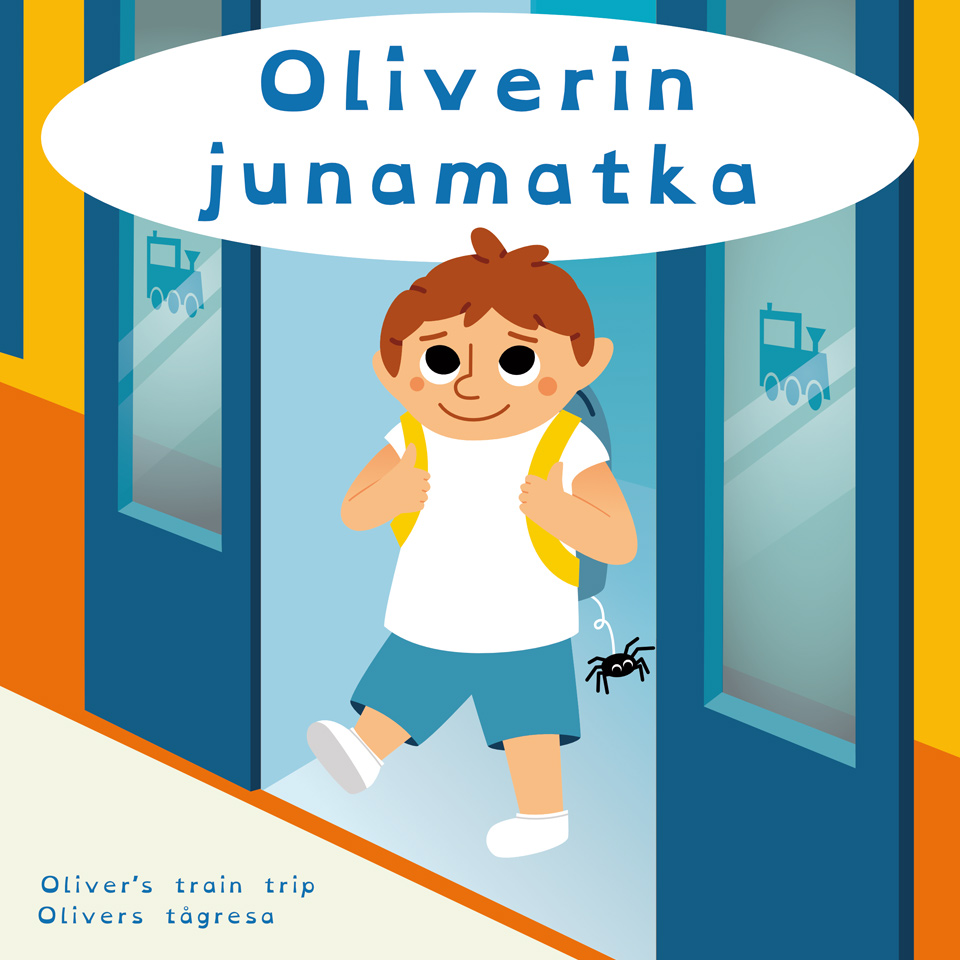
Oliverin junamatka is a picture book following Oliver and the grandmothers on a train journey. Finnish key word signs, illustrations and the story invite children and adults to explore, tell stories and talk together. The supplementary materials offer ideas for dialogic reading.
You can find the guide to dialogic reading further down this page.
Dialogic reading
Key word signs and activity boards will be published on separate pages later.
In this guide
What is dialogic reading?
Dialogic, or conversational, reading is an approach that supports interaction during shared reading with children. In a traditional reading session, the adult reads and the child listens. Dialogic reading techniques also encourage the child to take an active part. The aim is to encourage the child to become a storyteller with the adult’s support. The adult’s role is to draw out the child’s storytelling skills, provide informative feedback and adapt their own reading style to the child’s developmental level. Dialogic reading offers a range of techniques for increasing interaction during shared reading. It is well suited to supporting language development and emerging literacy in all children below school age. It also supports language development and communication in preschool children with language development difficulties or developmental delays.
Why read with a child?
Shared reading is a simple way to support a child’s language development, for example at home and in early years settings. Research shows that reading together has a positive effect on children’s language skills and learning to read. In addition to supporting emerging literacy, dialogic reading has been found to increase enjoyment of and interest in reading, improve interaction and communication between parent and child, lengthen attention spans and strengthen the parent–child bond. Dialogic reading can support a child’s development in areas such as vocabulary, language comprehension, storytelling, early literacy and interaction skills.
How can I use dialogic reading when reading together?
A range of techniques has been developed to support dialogic reading and help children develop their storytelling skills. These techniques can help adults encourage children to take an active part in an interactive reading session. Commenting, evaluating, expanding and repeating are techniques that support language comprehension and vocabulary development and form the basis of dialogic reading. Completion, recall, open-ended questions, questions using question words, and relating the story to personal experience offer ways to create different prompts. They also support the child’s expressive language and existing language skills.
The aim is not to fill a reading session with every possible technique, but to introduce a few ways to support storytelling skills. You can combine the techniques freely and use the examples for ideas while conversational reading still feels unfamiliar. To begin with, you can ask open-ended questions that encourage the child to respond with more than single words. Questions involving recall or the child’s own life are more demanding. You can adapt and increase the types and number of questions as the child grows older and becomes familiar with conversational reading.
Dialogic reading focuses on listening to the child and responding to their attempts to communicate. Instead of continually asking new questions, the adult can build the conversation around what the child initiates. As well as speech, these attempts may include pointing, other gestures, facial expressions or vocalisations. Noticing and responding to them allows the child to take an active part in the reading session. This may help create positive reading experiences and strengthen the child’s interest in reading. The child’s alertness and motivation also affect how smoothly the session goes. To support their motivation, it may help to think about their interests beforehand and use these to plan questions suited to their abilities. The aim of the questions is to encourage interaction and support a positive reading experience, rather than test what the child knows. When the conversation builds on what attracts the child’s attention and what they initiate, the reading session supports the development of interaction.
The basic structure of dialogic reading
Commenting and asking questions. The adult can ask the child a question about a picture or invite them to describe what is happening in the story on that double-page spread.
For example: ‘There are so many animals in the picture. What is happening here?’
Evaluating. The adult responds to what the child says, confirming or correcting their account. Praising the child’s observations helps maintain their motivation to make further attempts to communicate.
For example: ‘That’s right, Oliver is eating cereal for breakfast. You’re very observant — you spotted the spider straight away! Could it be on top of the backpack instead?’
Expanding. The adult listens to what the child says and adds more precise language or enriches the child’s expression with new information.
For example: ‘Yes, now Oliver and the grandmothers are inside the train, and the conductor is checking their tickets.’
Repeating the question. Once the adult has responded to and expanded on the child’s answer, they can reinforce the new vocabulary during the storytelling session and return to it later. When younger children are learning new words, you can ask them to repeat the new word.
For example: ‘Can you say “conductor”? Do you remember what the conductor did on the train?’
Different types of prompts
Completion. The adult can start a sentence and pause near the end, giving the child a chance to finish it. If the child has difficulty following the adult’s train of thought, the adult can give a clue to the target word, for example by sounding out its first sound or syllable, or using body language or signs.
For example: ‘At the station there is a yellow… (train). Oliver is having bread for a snack, but today you had…’
Recall. As the story progresses or comes to an end, the adult can ask the child questions about what happened in it.
For example: ‘How did Oliver travel? What did Oliver do with the grandmothers on the train?’
Open-ended questions. Open-ended questions give the child an opportunity to describe the events in the book in their own words, with the help of the pictures.
For example: ‘What is happening in this picture?’
Using question words. More specific questions using who, what, when, where, why and how can support the child’s vocabulary development and storytelling.
For example: ‘What is happening in the picture? What animal can you see in Oliver’s backpack? Where are Oliver and the grandmothers now? How did Oliver and the grandmothers get to the park?’
Relating the story to personal experience. You can also connect the events in the book to the child’s own life and experiences.
For example: ‘Do you remember what you saw when we went to the park? Do you remember which animals we saw there?’
Use of artificial intelligence
Artificial intelligence was used to review the language and style of the text.
Microsoft. (2026). Microsoft Copilot (large language model). https://copilot.microsoft.com
References
Dowdall, N., Melendez‐Torres, G. J., Murray, L., Gardner, F., Hartford, L., & Cooper, P. J. (2020). Shared Picture Book Reading Interventions for Child Language Development: A Systematic Review and Meta‐Analysis. Child Development, 91(2), e383–e399. https://doi.org/10.1111/cdev.13225
Ganotice, F. A., Downing, K., Mak, T., Chan, B., & Lee, W. Y. (2017). Enhancing parent-child relationship through dialogic reading. Educational Studies, 43(1), 51–66. https://doi.org/10.1080/03055698.2016.1238340
Mol, S. E., Bus, A. G., de Jong, M. T., & Smeets, D. J. H. (2008). Added Value of Dialogic Parent-Child Book Readings: A Meta-Analysis. Early Education and Development, 19(1), 7–26. https://doi.org/10.1080/10409280701838603
Pillinger, C., & Vardy, E. J. (2022). The story so far: A systematic review of the dialogic reading literature. Journal of Research in Reading, 45(4), 533–548. https://doi.org/10.1111/1467-9817.12407
Towson, J. A., Gallagher, P. A., & Bingham, G. E. (2016). Dialogic Reading: Language and Preliteracy Outcomes for Young Children With Disabilities. Journal of Early Intervention, 38(4), 230–246. https://doi.org/10.1177/1053815116668643
Zevenbergen, A. A., & Whitehurst, G. J. (2003). Dialogic reading: A shared picture book reading intervention for preschoolers. In On Reading Books to Children: Parents and Teachers (pp. 170–192). https://doi.org/10.4324/9781410607355
Özcan, S. (2026). The effect of dialogic reading interventions on narrative skills in the preschool period: a systematic review. Frontiers in Education (Lausanne), 11, Article 1817388. https://doi.org/10.3389/feduc.2026.1817388