


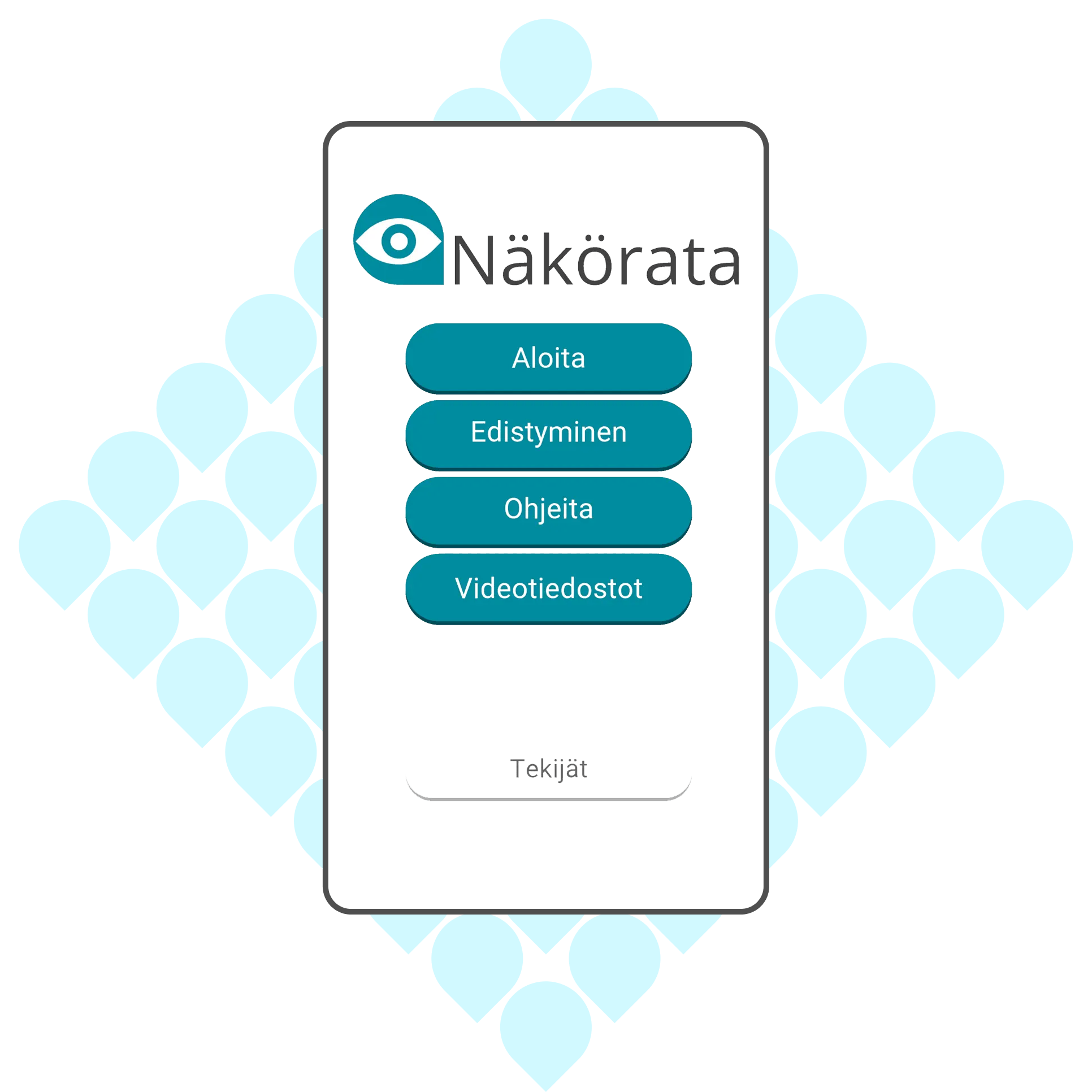
The Näkörata app can help you make more effective use of your lipreading skills. Vision complements the information you hear in speech: sounds that are difficult to hear can be easier to identify visually. Lipreading is particularly valuable in noisy or reverberant listening environments and when hearing is impaired.
Näkörata is an app developed for lipreading practice, with a wide range of exercises. These include distinguishing word lengths, words, sentences and stories, building sentences from words, memory games and bingo.
Download links
- Download Näkörata from Google Play (Android 8.1 or later)
- Download Näkörata from the App Store (iOS and iPadOS 15.0 or later)
Näkörata aims to
- encourage people to watch the speech movements visible on a speaker’s face
- increase the benefit they gain from lipreading
- help them apply these skills more widely by practising recognition of different speakers’ speech movements
A versatile, easy-to-use app
Näkörata is simple to use. Its basic structure may already be familiar from the Kuulorata app. Näkörata’s ease of use and game-based activities encourage sustained practice.
You can choose the difficulty level of each exercise every time you use it, and the app gives you feedback on your performance and progress. Receiving a medal after doing well is a pleasant reward. Game-based practice encourages you to improve your results.
You can also watch the videos in slow motion and repeat them as often as you need. The app shows your weekly practice time in a progress bar at the top of the screen, divided into three 15-minute sections.
Näkörata contains a very wide range of exercises. The word-level exercises focus mainly on closely comparing and distinguishing speech sounds, but there are also slightly longer sentences and three-sentence stories. These require attention to the overall shape of an utterance rather than its fine details.
The app’s videos feature both female and male speakers. The clarity of speech movements varies between people, so it is useful to practise recognising several different speakers’ movements. Some sentence-discrimination tasks also include facial expressions.
Who is Näkörata for?
Anyone of primary-school age or older can practise with the app. With support from parents, suitable parts of it can also work well for younger children.
The exercises are also well suited to adults. Previously, Finnish-language lipreading practice materials were not available in a digital mobile format that you could carry in your pocket. Näkörata was created to meet this need.
The content and exercise types in Näkörata were designed by Kerttu Huttunen, Professor of Logopedics at the University of Oulu, and Associate Professor Satu Saalasti, formerly at the University of Helsinki and now at the University of Eastern Finland.
Why practise lipreading?
Speech perception involves several senses: without even noticing, we use vision as well as hearing. Even babies benefit from watching speech movements as their speech develops (see, for example, [1–2]), and lipreading ability has also been found to be associated with literacy.
Lipreading alone, also called speechreading, means understanding speech purely by watching speech movements, without hearing it. Most people find this difficult. However, research shows that practising the skill produces results, although achieving them takes persistence ([3–7]).
Improved lipreading ability has been found to support better speech perception when a person receives a cochlear implant to enable hearing [8]. Practising for around 10 minutes several times a week has also been found to help improve children’s lipreading skills [6].
We hope you enjoy plenty of rewarding practice!
Privacy and security
Information about privacy in Näkörata is available in the app’s privacy notice.
References
- Belteki, Z., van den Boomen, C., & Junge, C. (2022). Face-to-face contact during infancy: How the development of gaze to faces feeds into infants’ vocabulary outcomes. Frontiers in Psychology, 13, 997186. DOI: 10.3389/fpsyg.2022.997186
- Morin-Lessard, E., Poulin-Dubois, D., Segalowitz, N., & Byers-Heinlein, K. (2019). Selective attention to the mouth of talking faces in monolinguals and bilinguals aged 5 months to 5 years. Developmental Psychology, 55(8), 1640-1655. DOI: 10.1037/dev0000750
- Bernstein, L. E., Jordan, N., Auer, E. T., & Eberhardt, S. P. (2022). Lipreading: A review of its continuing importance for speech recognition with an acquired hearing loss and possibilities for effective training. American Journal of Audiology, 31(2), 453-469.
- Buchanan-Worster, E., Hulme, C., Dennan, R., & MacSweeney, M. (2021). Speechreading in hearing children can be improved by training. Developmental Science, 24(6), e13124. DOI: 10.1111/desc.13124
- Lonka, E. (1995). Speechreading instruction for hard-of-hearing adults. Effects of training face-to-face and with a video programme. Scandinavian Audiology, 24(3), 193-198. DOI: 10.3109/01050399509047534
- Pimperton, H., Kyle, F., Hulme, C., Harris, M., Beedie, I., Ralph-Lewis, A., Worster, E., Rees, R., Donlan, C., & MacSweeney, M. (2019). Computerized speechreading training for deaf children: A randomized controlled trial. Journal of Speech, Language, and Hearing Research, 62(8), 2882-2894. DOI: 10.1044/2019_JSLHR-H-19-0073
- Schmitt, R., Meyer, M., & Giroud, N. (2023). Improvements in naturalistic speech-in-noise comprehension in middle-aged and older adults after 3 weeks of computer-based speechreading training. npj Science of Learning, 8(1), 32. DOI: 10.1038/s41539-023-00179-6
- Strelnikov, K., Rouger, J., Barone, P., & Deguine, O. (2009). Role of speechreading in audiovisual interactions during the recovery of speech comprehension in deaf adults with cochlear implants. Scandinavian Journal of Psychology, 50(5), 437-444. DOI: 10.1111/j.1467-9450.2009.00741.x
Text: Kerttu Huttunen & Satu Saalasti (2026)